Deutsche Version | Version française
Dear members,
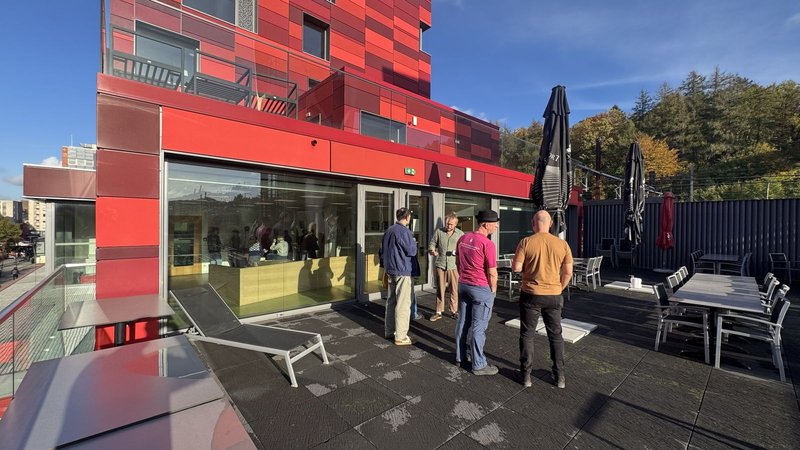
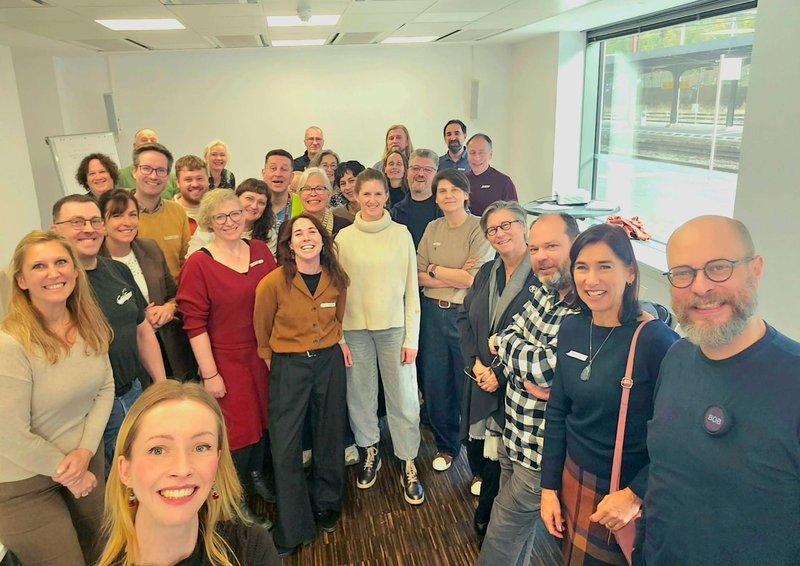
From 26 to 30 October 2026, AHA Lëtzebuerg hosted the second Autumn School of the European Humanist Services Network (EHSN) on humanist existential care. Around 40 professionals from eleven countries spent a week together at the youth hostel in Esch-sur-Alzette. The programme and organisation were in the hands of the EHSN, above all Lindsay de Wal; AHA provided the venue, paid for the room and welcomed the guests to Luxembourg. Tanja Frank and I accompanied the week on behalf of AHA.
With this report I would like to tell you, in as much detail as possible, what was said, tried out and discussed over these five days. The daily reports follow the programme; at the end you will find what, in my view, the week means for AHA. Personal stories that participants told in a protected setting, as well as the content of the workshops and simulations, stay in the room, as agreed; in those cases I report only on the format.
At a glance
- When and where: 26–30 October 2026, Esch-sur-Alzette youth hostel; excursion to the University of Luxembourg’s Belval campus on Thursday.
- Who: around 40 participants, speakers included, from the Netherlands, Belgium, Germany, France, Luxembourg, the United Kingdom, Norway, Sweden, Denmark, Canada and the USA (by video).
- Organiser: the European Humanist Services Network (EHSN), since January 2024 a network of 21 member organisations of Humanists International. It was the second edition, following a conference in Berlin in October 2025.
- AHA’s role: host (venue, room hire, welcome); programme, organisation and catering: EHSN.
- Outcomes: a planned joint book, an intended special issue of the journal Secular Studies, a training institute (I-HEC) under the EHSN umbrella from 2027, and the next Autumn School in 2027.
The programme in brief
- Monday: arrival, presentation of the EHSN, keynotes by Christian Meyers (University of Luxembourg) on existential anxiety and by Greg Epstein (Harvard/MIT, by video) on the “three-headed” crisis of our time.
- Tuesday – “Crisis, moral injury and humanist response”: keynote by Niels De Nutte (VUB) on the secular paradox; practice panel with Yvan Dheur, Ingun Steen Andersen and Alexandra Rondas; workshops and a fishbowl simulation with Winnie Belpaeme.
- Wednesday – “Community and collective resilience”: keynote by Gaby Jacobs (Utrecht) on living in the borderland; panel on collective crises; workshops on supervision (Liz Young) and aikido (Niels De Nutte).
- Thursday – “Methods, professional identity and sustainability”: Birgitte Fredriksen (Oslo) on nature conversations; workshops; tour of the Belval campus and encounter with the Spirit4Care project.
- Friday – “Sharing knowledge and next steps”: book and journal project, training institute, closing round.
Monday 26 October 2026
Pausing in the fog
Humanist existential care: at the opening of the EHSN Autumn School in Esch-sur-Alzette, two keynotes asked the big questions – and both ended up with Sisyphus.
Around 40 professionals from eleven countries – from Norway to France, from the United Kingdom to the USA, from where one speaker joined by video – came together this week at the youth hostel in Esch-sur-Alzette. The invitation came from the European Humanist Services Network (EHSN); the host was AHA Lëtzebuerg. The theme of the Autumn School: humanist existential care in times of global crisis.
Even the term itself, EHSN director Lone Ree Milkær openly admitted, is a compromise. “Chaplaincy” and “pastoral care” sound religious; “humanist existential care” is meant to describe what humanist carers do in hospitals, prisons, the military and universities, but also outside such institutions, for instance in their own community houses: supporting people in crisis without recourse to the supernatural.
A small network with big ambitions
The EHSN has existed since January 2024. It works with one full-time post and three part-time staff who lead the sub-projects on existential care, youth work and ceremonies. There are now 21 partner organisations, all of which must be members of Humanists International; a Canadian one joined most recently. The network is funded by its members, the national associations – each according to its means. Milkær formulated the goal without false modesty: high-quality humanist services for all Europeans who want them. For existential care, that means establishing it at national level as a lifelong career with academic prospects and consolidating it at European level as a profession. The network’s starting point is the unequal treatment of non-religious people, for whom in many places there is no equivalent provision.
Christian Meyers: anxiety as a sign of care
The first lecture was given by Christian Meyers, lecturer in educational sciences at the University of Luxembourg. He began with Sartre’s “Existentialism Is a Humanism” and with Simone de Beauvoir: one is not born a humanist – one becomes one. He told the story of his own path in nine stages. The first: as a twelve-year-old on a trip to Japan, a boy asked him whether he believed in God – and he did not understand the question. Only when he met a Shinto priest and visited the temples of Kyoto did he realise that he had grown up in a practising Catholic family and that other religions exist.
The main part was devoted to the anxieties of the present. Drones, smartphones, smart glasses, surveillance cameras: “All of them see, record or transmit, yet none of them listens.” Meyers interpreted them as symptoms of an attention economy and of an ideology that, under the banner of the “Dark Enlightenment”, wants to leave democracy behind. Today’s anxieties, he said, are diffuse and chronic, with no clear moment of danger and no all-clear; they lead to helplessness, doomscrolling and retreat into closed groups. And yet: “Feeling this fear is not a weakness, but a sign of care for the world and for one another.” Young people in particular, he said, have many fears, and nobody listens to them.
As a historical anchor, Meyers cited the founding of the Dutch Humanistisch Verbond in 1946: Jaap van Praag’s answer to post-war nihilism was not a doctrine but a place of encounter. For practice, Meyers proposed seven steps for accompanying young people with their anxieties – from “making the fear concrete” to “strengthening community”. He closed with Camus: Sisyphus knows that the stone will roll back down, and carries on – “Lucidity, not hope”.
In the discussion, the question arose whether humanists should use their opponents’ tools to reach young people. Meyers counselled patience: build things up over time, make thinking possible. One objection was deliberately left open: how does the humanist virtue of deceleration square with the urgency young people feel in the face of the climate crisis? Lindsay de Wal, head of the existential care sub-project, collected such open questions so that they could be worked on over the course of the week.
Greg Epstein: the three-headed monster
Greg M. Epstein, humanist chaplain at Harvard University and MIT, joining by video from the USA, called the gathering “historic”: the institutions being created here, he said, are “a correction of the historic record”. He described three parallel crises – climate, technology, shifting values – as the “three-headed monster of change”. Where some see late capitalism, he sees “early apocalypticism”. The rhetoric of some tech billionaires, for example in Marc Andreessen’s “Techno-Optimist Manifesto”, where slowing down AI development is put on a par with murder, makes technology appear to leave us no alternative.
His image for the present: thick fog. Anyone who speeds through it in order to arrive first puts everyone in danger. Anyone who stops and looks after the others gets through. When someone in the audience objected that most people do not even have a car, Epstein responded with an invitation: “Help us find better metaphors.” Lindsay de Wal suggested the bicycle.
Epstein also spoke openly about failure. A physical space for humanist community in Cambridge, Massachusetts, which he called a “Humanist Club”, had not proved sustainable. After the 2013 Boston Marathon bombing, humanists were excluded from the public memorial service; they protested, loudly, compassionately and with dignity, and even without full success the fight had been worth it. He too ended up with Sisyphus – but with a telling twist: Sisyphus is happy because he is not alone.
Two paths, one goal
Different as the two lectures were, they arrived at the same stance: slowing down in an accelerated world, listening where everyone is transmitting, and carrying on without any guarantee of success. The first day painted the big picture and asked big questions. The detailed practice of existential care was on the programme for the days that followed.
Tuesday 27 October 2026
The human is always there
Second day of the EHSN Autumn School: a historian dissected the secular paradox, three practitioners showed what humanist care means at the airport, in the barracks and at the university – and in the afternoon it was time for the practice itself.
Niels De Nutte: the secular paradox
The second day, under the heading “Crisis, moral injury and humanist response”, was opened by the historian Niels De Nutte of the Vrije Universiteit Brussel and the Flemish umbrella organisation deMens.nu. The title of his lecture – “Humanism in times of global polarisation and transnational crisis” – had been set for him by the organiser; he added a question mark, “my way of keeping my agency”. And he began with a warning: “crisis”, he said, is a word we use too lightly.
Those who call themselves humanists like to invoke the Stoics, Montaigne or the Enlightenment. De Nutte tempered this lineage: there are affinities with thinkers of the past, but organised humanism as we know it is barely more than 200 years old – and one should beware of invented traditions. He distinguished two roots: in countries with a dominant, mostly Catholic church, unbelief arose out of conflict, anticlerical and combative. In the English-speaking world, by contrast, humanism grew out of Ethical Societies, liberal Protestants and liberal Jews. The family tree of humanism, he argued, is itself a product of crises.
Against alarmism, De Nutte invoked Karl Popper: optimism is a duty, the future is open. In the light of the past 200 years, he said, one should neither dramatise the present state of the world nor believe that everything will be fine once the next crisis has been overcome. The world has become multipolar, national and religious identities are merging, as in Israel and Gaza or between India and Pakistan. He used pop culture to show how identity politics simplifies world views: Star Trek stands for the utopia the 1960s were striving for; Star Wars for the simple pattern of good versus evil – less beautiful, but more comfortable. Anyone who wishes for the world of Star Trek but experiences it as Star Wars will eventually ask only which side they are on: Jedi or Sith. Taking the example of the French gilets jaunes – people outside the cities, poor, predominantly men, who feel left behind and vote for the far right – he warned that humanists, when advocating sustainability, often overlook the economic side. A racist US election poster from 1866 against the “Freedmen’s Bureau” showed how old the pattern is of portraying social benefits as a reward for the lazy at the expense of the hard-working – a discourse that remains racist to this day, even if it is not always tied to skin colour.
At the centre was the “secular paradox”: the secularisation thesis has proved wrong, he said; religion is back, having never been gone. Not scientism, but the scientific method, remains viable. And identity politics is here to stay. Whoever clings to a single identity must reject nuance. De Nutte’s antidote: nuance does not mean watering down; one should surround oneself with people who make distinctions, and not delete those who think differently from one’s list of friends. Asked by the audience about the tension between universal and particular humanism, he replied that one should stand up for all of one’s affiliations rather than choosing just one.
Nor did he spare his own movement. Most humanist organisations, he said, had chosen the path of adaptation in order to obtain public funding, and in doing so had forgotten to work towards social change. Secular societies are the most inclusive – but none is truly secular, as the example of the USA shows: strictly secular on paper, largely religious in its population. In Belgium, on the other hand, education and healthcare are largely in Catholic hands; the fact that these institutions hardly act in a Catholic way today is no guarantee that it will stay that way. Humanism, he said, needs both: resistance to injustice and a shared project with people who do not always think as one does oneself. With that, De Nutte returned to his opening image: better the Star Trek ideal than the camp logic of Star Wars.
Two questions on his final slide accompanied the week: should humanist professionals work towards a society in which they become superfluous – and be glad about it? And: are humanists religion-like, related to religion, or activist? “Not everything is possible.” The fact that most Europeans hardly voice their non-religiosity out loud, but simply find religion a matter of indifference, does not make the answer any easier. As a model for a public voice, De Nutte named the Dutch philosopher Stine Jensen, who in her book Goddeloos argues for a more open atheism, willing to engage in conversation.
“The human is always there”: practice at the airport, in the barracks and at the university
What humanist existential care means in concrete terms was shown by the practice panel that followed, moderated by Lindsay de Wal. Yvan Dheur works as a humanist carer at Brussels Airport in Zaventem – a place of stress, security and speed, a liminal zone. Most of the questions he is asked are: where is the toilet, where is the smoking room, where is my gate? Yet on average seven travellers a day are stranded there, often because of visa problems. There is little time for relational work; people have to catch their flight. In extreme cases, such as the attack on the airport in 2016, the first priority is saving lives. The rest of the time, his work consists mainly of having a coffee with people.
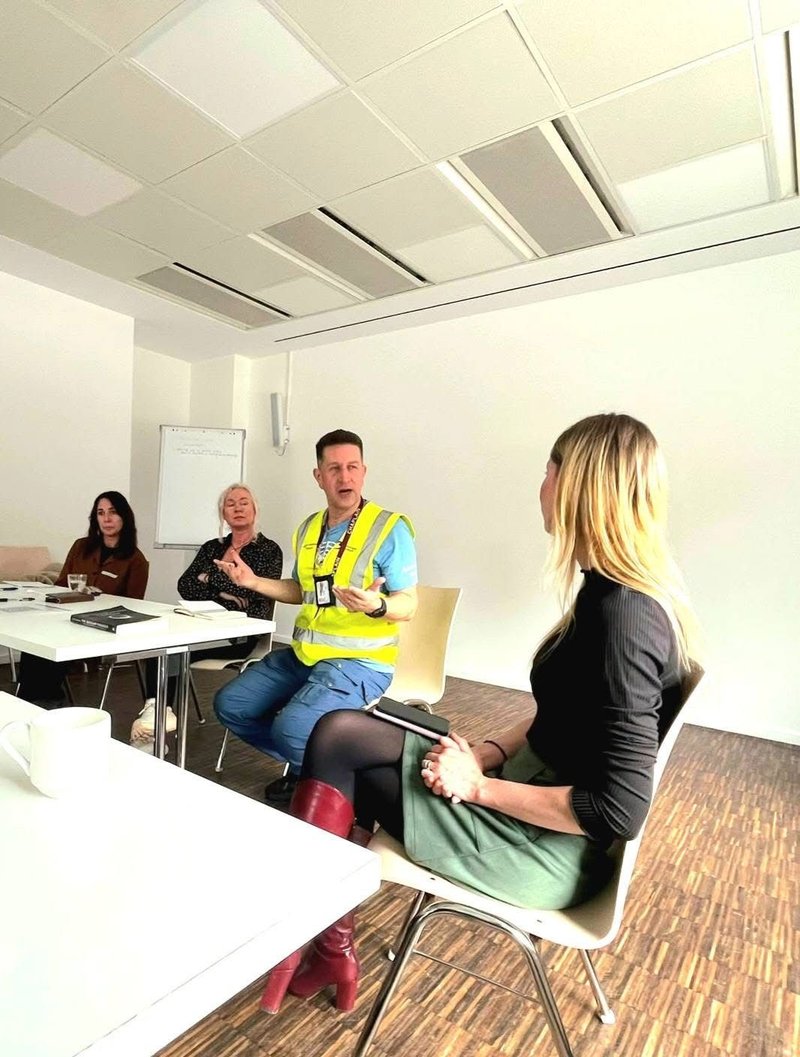
Ingun Steen Andersen of the Norwegian Human-Etisk Forbund described how humanist carers in Norway work at universities, in hospitals and in the military, and are building a profession together. Their work, she said, reaches beyond the individual: creating spaces for dignity, dialogue and self-determination – and speaking out when human dignity is violated. Norway talks a lot about crisis preparedness and individual resilience; Andersen asked about existential resilience. “We work for deceleration”, she said – not as passivity, but as an active pausing.
Alexandra Rondas is a Moral Counsellor in the Belgian army and works with moral distress. She described how a soldier, after dry training, froze on the firing range when she realised what it means to hold a loaded weapon in her hands. “The soldier can be trained, but the human is always there — and we must create a space where the human can continue to exist.” Her greatest value, she said, lies not in the highly visible deployment abroad, but in offering time and a protected space for thoughts that would be considered a nuisance among comrades – such as the question of whether it is worth leaving one’s family. She is part of the institution, but not “one of them”; that allows soldiers to speak differently. She summed up moral injury in a question: who am I, given what I have done, not done or seen? It can make people ill, but it need not; those who have an inner compass can understand it as part of being human. It is important, she said, not to pathologise people who neither want nor need it.
Tensions were also raised. Dheur reported resistance from religious chaplains who did not appreciate the intrusion into “their” sacred world, and from airport managers who calculated in terms of efficiency – while church chaplaincy is taken for granted. He recalled the video in which US Secretary of Defense Pete Hegseth, in December 2025, criticised an army guide for promoting “secular humanism” and declared: “Our chaplains are chaplains, not emotional support officers.” Dheur’s verdict: “We are winning the game, but sometimes it goes slowly.”
Lindsay de Wal’s image of “spiritual first aiders” met with agreement on the panel but with objection in the audience: one is not first aid, but works long-term as a specialist. De Wal put this in context: in the British context, “first aid” means help without diagnosis or waiting list – professional, but low-threshold. Andersen named the fundamental problem: in Norway, people outside the institutions who ask whether they can use the service are often told no, because there is nobody there. Ensuring professionalism and accessibility at the same time is one of the open tasks. That humanist care need not be tied to institutions is shown by Belgium: there are trained volunteers there, and in the “Houses of Humanity” (huizenvandeMens) run by deMens.nu anyone can find care, without any hospital bed or barracks.
At the end, each panellist left the room with one sentence. Andersen: “Stones do not open quickly.” Dheur: “We have to take care of the carers.” And Rondas: “We are in the business of meaning-making when meaning is lost.”
Diving into practice
In the afternoon, the Autumn School moved from talking about care to care itself. In parallel with a workshop led by Asbjørn Fretheim, humanist carer at St Olav’s Hospital in Trondheim, Liz Young – who runs a master’s programme in existential and humanist pastoral care in London and is a humanist carer in the British National Health Service (NHS) – spoke under the title “Paying attention to our own spirits” about care for the carers themselves (“spiritual accompaniment”): who accompanies the accompanists, and what does supervision look like as care becomes more professional? In doing so, she took up what Yvan Dheur had called for in the morning: taking care of the carers. In the workshops, participants experienced existential care first-hand; what was said there stays there. In a “fishbowl” with the Ghent-based carer Winnie Belpaeme, a conversation between a carer and a client was simulated while the audience in the outer circle analysed the situation and the course of the conversation. The client being role-played was a young student who was worried about the state of the world – and about whether to continue her studies without disappointing her parents. Above all, she felt abandoned and lonely: because her fellow students were enjoying life and had no worries, and because she believed she could not talk to her parents about her doubts about her studies. In the afternoon, then, the very anxieties of young people that Christian Meyers had described the day before returned. Therein lay its value: anyone who wants to professionalise humanist care must not only describe it but practise it – and experience first-hand what it means to listen without judging. Belpaeme summed up what constitutes the core in seven principles on a handout: a focus on personal meaning, which is unique, changeable and often unconscious; the values and agency of the other person; caring presence instead of problem-solving; a human-to-human encounter in which nobody is an expert except in listening; genuine contact as an indispensable precondition; listening without judgement, “when life seems random and answers are lacking”; and finally a fundamental love for fallible and resilient human beings. Whereas the European standards define the profession mainly by demarcation – no therapy, no religious rites, no proselytising – this list provides a positive description.
Wednesday 28 October 2026
Living in the borderland
Third day of the EHSN Autumn School: the Utrecht professor Gaby Jacobs described humanist care as a border practice for a life in transitions, a panel asked what it can achieve in the face of war, institutional failure and the climate crisis – and the afternoon was about supervision and aikido.
Gaby Jacobs: living in the borderland
The third day was held under the heading “Community and collective resilience”. It was opened by Gaby Jacobs, professor of “Humanist Chaplaincy Studies” at the University of Humanistic Studies in Utrecht, who researches the need for humanist care and its effectiveness; her book Chaplaincy for a Plural World is available in English. Her theme: humanist existential care as a “border practice”.
Her diagnosis of the times began with secularisation, which requires many people to find their own way and to decide for themselves what a good life is. At the same time, crises were piling up: the rise of radical right-wing parties, the climate crisis, human rights violations, the gap between rich and poor, the housing shortage, an overstretched healthcare system, loneliness. This, she said, feeds an “us versus them” way of thinking, as if life were a zero-sum game in which the good life of others diminishes one’s own. With the Flemish psychiatrist Dirk De Wachter, Jacobs spoke of “Borderline Times”: what psychiatry describes as a disorder of the individual now characterises an entire society. And with Anthony Giddens, she described the self as a “reflexive project” for which everyone is solely responsible, in institutions that outsource illness, death and guilt from everyday life and repress moral questions. The consequences: loneliness, meaninglessness, moral impoverishment.
On top of this, suffering accumulates. The US author Bruce Feiler has calculated that adults experience around three dozen disruptions in the course of their lives, in love, identity, beliefs, work and the body, and that three to five of these become “lifequakes” lasting five years on average. According to this, we spend half of our adult lives in transition. Jacobs drew a self-critical conclusion from this: humanist care, too, often tacitly assumes that life runs in a straight line and that crisis is the exception. Yet life, she said, takes place in the transitions, not between them.
For this “border life”, Jacobs sketched a small theory. For Karl Jaspers, boundary situations such as death, suffering, struggle and guilt are those moments that bring us closer to existence. The philosopher Ami Harbin describes disorientation, in which one no longer knows how to go on, and for which we find bodily images: losing the ground beneath one’s feet, being thrown off course. Finally, the anthropologist Michel Agier shows that border spaces alienate, but can also open up new possibilities, identities and relationships. Many people know such border lives, for many they are a permanent condition – and humanist care, she said, offers precisely the in-between spaces in which they can become encounters. Jacobs therefore spoke of a “resouling” of society – well aware that the word “soul” is ambiguous. She used it for something that points beyond the individual ego.
At the level of the individual encounter, Jacobs drew on the paediatrician and psychoanalyst Donald Winnicott, for whom the transitional space is a “resting place”. With the psychiatrist Daniel Stern, she spoke of “moments of meeting”, moments of genuine encounter that one still remembers years later: “I was seen.” Such moments cannot be manufactured, she said, but the conditions under which they arise can be created – and those who have experienced them can give them to others. The Utrecht humanist Ton Jorna calls this a “participating professionalism”: genuine attention, presence, recognition of the otherness of the other. Jacobs even wanted to rethink language. The “individual”, she noted, is by etymology the indivisible, yet we all live in multiple, relationship-dependent identities; meaning arises not only within, but between people.
At the level of society, Jacobs named eight characteristics of humanist care, from encounter and hospitality through learning and ritualising to “resistance in small things”. Hospitality, she said, means being allowed to be disoriented. In the Netherlands, humanist carers therefore also work with groups, in prisons and in communities, and deliberately with mixed groups, because the differences matter. Rituals provide support in times of uncertainty and can reconnect people with nature, with others and with themselves; seasonal festivals are part of this. And finally, the “orientation to the good, not God”: with the Leuven ethicist Roger Burggraeve, Jacobs spoke of “small goodness”, which happens without witnesses, quietly and without triumph.
Her conclusion: humanist care is part of a critical humanism that gives no easy answers but leaves room for ambiguity and creates opportunities to connect with our shared humanity. “Micro-revolutions can change the world”, Jacobs said. Her final slide belonged to the psychiatrist Irvin Yalom and his image of ripples. According to it, each of us, often without knowing it, creates “concentric circles of influence” that continue to have an effect for years, sometimes for generations, because what we bring about in others is passed on by them – “much like ripples in a pond”.
“Smile, it shows your teeth”: humanist responses to collective crises
The panel that followed, moderated by Niels De Nutte, was about collective crises. Hans De Ceuster, head of humanist care in the Belgian army, began with his grandfather. In the autumn and winter of 1944/45, German V-weapons struck Antwerp day after day; De Ceuster played the room the drone of the bombers. His grandfather was waiting at the time for his sweetheart, later the grandmother, and did not know whether she had been killed in the devastating hit on the Rex cinema. His rule for life: “Smile, it shows your teeth.” De Ceuster has turned it into a song for his children. And he drew the line to the present, to Ukraine, where people live with the sound of drones controlled from a distance and increasingly with the help of artificial intelligence. He openly admitted that he shares the fear of them.
Birgitte Fredriksen, humanist carer at the University of Oslo, described a more modest, grounded approach. In Oslo, religious chaplains and humanist carers do not work side by side but deliberately together. Gaby Jacobs’ lecture that morning had helped her understand her own work better, not as a manual but as a tool for reflection. Her team creates “third spaces” on campus: groups that read together or work artistically, a quiet room meant to be open to all – which, she said, is not easy – and a place in the university’s crisis team. There, students also practise arguing with one another, without fear of speaking up or being “cancelled”. In Norway, she said, this is called a “community of disagreement”: dialogue does not mean harmony, but the courage to disagree.
Jacobs contributed two Dutch examples: the earthquakes in the province of Groningen after decades of natural gas extraction, and the childcare benefits scandal, in which the tax authority suspected families on the basis of their origin, falsely accused them of fraud and demanded repayments that drove many into ruin. For Jacobs, a case of institutional violence. Humanist care, she said, has so far paid too little attention to such fears, although it has much to offer. In Groningen, people were angry because those responsible did not come to listen to them – but the humanist carers did come.
From the previous day’s survey, De Nutte picked up the keyword “democracy”. Fredriksen told how her team mediated between the university leadership and students when a conflict over a student group and a controversial guest speaker was weighing on the campus. De Ceuster called war “anti-human and anti-humanist” – and yet, he said, we do not live in a world without weapons. The army he knows is there for defence, and it needs soldiers with a conscience, not ones who kill on command. He recalled how people have repeatedly tried to limit weapons: as early as 1139, the Second Lateran Council banned the crossbow – though only in combat against Christians. He described the transitions soldiers go through, from civilian to soldier, from soldier to combatant on deployment and from warrior back into society, and the “decompression rituals” with which the army accompanies this return. Prevention of radicalisation, for instance after the case of a Belgian soldier who threatened a well-known virologist in 2021, mostly only says what is forbidden. But societies, he said, move forward through positive action.
On the subject of climate, the microphone went to the Dutch participants, who offer courses in “Active Hope” and create free spaces in which climate activists can draw strength and express their grief over what has been lost. Jacobs added that young people see that certain futures are no longer within their reach; many losses need to be acknowledged, including with rituals. De Nutte asked the uncomfortable questions: should we strive for hope at all? And must we, on scientific grounds, restrict our freedom, which means so much to humanists? Fredriksen replied that individual freedom is always bound up with the freedom of others. In her nature conversation groups she often hears young people say “I’m not doing enough”, when in fact it is about shared responsibility. De Ceuster warned against burdening people with guilt and shame; one should inspire and show good examples. And Jacobs made clear: humanism has never been the doctrine of absolute freedom and should not place human beings at the centre of the universe. De Nutte added that animals, too, belong in our ethics.
The question Jacobs herself raised remained open: where does humanist commitment to democracy cross the line into party politics? She had no answer. The Dutch participants advised taking one’s own role as a life-stance community seriously; from Norway came the observation that equality and dignity as the foundation of democracy are undisputed, whereas the boundary with politics is not. Finally, De Ceuster presented a children’s book developed by carers in the Belgian army to take away children’s fear of war: “La paix”, peace. He invited people to translate it into further languages.
Survive or change? Supervision and aikido
In the afternoon, the focus returned to practice. In parallel with a workshop by Ingun Steen Andersen on dialogue formats, Liz Young addressed the question of who actually accompanies the carers. The basis was a new study from New Zealand (Weld, Rankine and Browne, 2026), which identifies six conditions for psychological safety in supervision: free choice of supervisor, the supervisor’s humility, a non-judgemental attitude, adaptation to the supervisee’s stage of development, genuine concern for their well-being, and an “emotional container” that makes trust possible. Understood in this way, supervision can become a place of refuge. Young, however, posed an uncomfortable question: should supervision help carers survive in a toxic environment – or should it prompt changes that make the environment less toxic? This brought back, at the level of the individual professional, what Niels De Nutte had reproached humanist organisations with the day before: the danger of settling in instead of bringing about change.
In small groups, working from a case, participants drafted the ground rules for a safe supervision space from the perspective of different parties. One group, which put itself in the supervisor’s shoes, named a clear, multi-year contract, fixed appointments instead of emergency calls, and supervision outside one’s own institution – the latter perhaps the precondition for not only enduring a toxic environment but also naming it. The other group, which took the carer’s perspective, wished above all for one thing: to be welcomed by a warm-hearted supervision.
To close, Niels De Nutte invited participants to an experiment: what can existential care learn from aikido, the Japanese martial art that absorbs and redirects the other person’s energy instead of striking back? The aim was to create and maintain connection without attacking, fighting or fleeing. The lesson could be summed up in three sentences: maintain the connection. Don’t push too hard. Don’t back away. After a day that had revolved around polarisation, contested spaces and the line with party politics, this was perhaps the most vivid answer.
Thursday 29 October 2026
Neither therapy nor activism
Fourth day of the EHSN Autumn School: the Oslo-based carer Birgitte Fredriksen showed how “nature conversations” give students with climate anxiety room to breathe – and on the Belval campus it became clear that spiritual care is also conceived without a religious framework.
Birgitte Fredriksen: nature conversations
The fourth day was devoted to methods, professional identity and sustainability. Birgitte Fredriksen, humanist carer at the University of Oslo, began without a lecture: she showed the image of a vast, dark landscape and asked what it evoked. The answers varied widely, from a menacing foreboding as in “The Lord of the Rings”, through the light in the background, to awe at a beauty in the face of which one feels small. That, Fredriksen said, is exactly what such images do: they create room for grief and joy, fear and hope, love of nature and anger at what is happening to it.
In Oslo, she offers such “nature conversations” together with the university’s Green Office and young psychologists from the climate committee of their professional association, supported by the Norwegian Human-Etisk Forbund and now also in Trondheim and Volda. The impetus comes from the ecological crises, a waning commitment to climate and nature, and the alarming number of students who report loneliness and psychological distress. Climate anxiety, Fredriksen stressed, drawing on the Norwegian psychologist Per Espen Stoknes, is not an illness to be cured but a rational response to a real threat – and to the gap between knowing about the crisis and not knowing how to act.
The nature conversations are explicitly “neither therapy nor activism”, but a “community of inquiry” in the sense of the educational tradition from Dewey to Lipman: a place where feelings, thoughts, questions and experiences are shared. A fixed framework with facilitation and a shared group ethos provides safety; arrival is followed by a short introduction, exchange, reflection and a closing. Topics include one’s own path into engagement, feelings, responsibility, relationships, values and the future. On offer are two-hour workshops, closed groups over five sessions and a monthly open meeting, outdoors when possible. Two groups in particular come: lonely students looking for a place to talk, and burnt-out activists. Many reported that it helps them to acknowledge the limits of their own room for manoeuvre. Accompanying research is under way; in Fredriksen’s assessment, the first results are promising. Her own path began when the forest behind her parents’ house was cut down and she, angry and sad, became a “forest detective”.
The discussion turned to a short video about a teenage girl’s “doomscrolling”. Christian Meyers, who on Monday had still spoken of lost young people, now suggested that adults may see only their own anxieties when they look at young people from the outside. Others described the contradictions in which young people live: caring for the planet and their fellow human beings while at the same time being good consumers; being held personally responsible for everything, from their own appearance to the climate – with guilt and powerlessness as the result. Someone cautioned against confusing individualism with individualisation, that is, an attitude with the social process that shifts burdens onto the individual. The term “doomscrolling” itself was criticised as condescending, because the things young people read about are real; others saw in it a form of self-numbing. The room let both interpretations stand. One participant suggested that we should trust young people more to view their own media consumption critically, rather than seeing them primarily as victims.
Alone, yet together
Three parallel workshops dealt with loneliness, with handling difficult emotions and with learning from mistakes. In Nikki van Biemen’s workshop “Alone, yet together”, the form itself became the message: after a poem about loneliness, each person chose an image and connected it with their own humanist world view; afterwards, many individually shaped pieces of clay came together to form a joint work.
Spiritual care without a religious framework
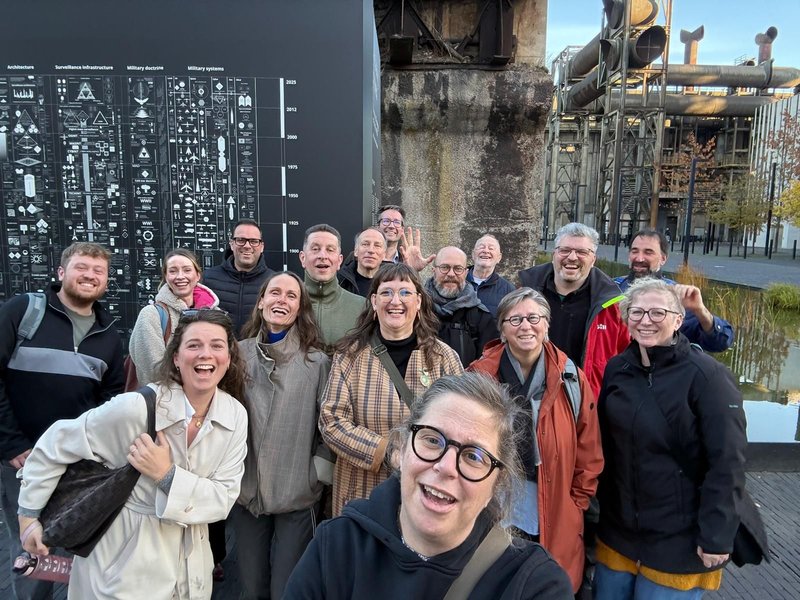
In the afternoon, as a lecturer at the University of Luxembourg, I led the group, together with Tanja Frank of AHA Lëtzebuerg, around the university campus in Belval, which has grown up between the disused blast furnaces of the former steelworks. The tour was very well received by the participants. There, Prof. Marie Friedel presented the EU co-funded project Spirit4Care, in which universities from Belgium, Portugal and Luxembourg aim to anchor spiritual care in training as part of holistic nursing care. The definition it is based on covers questions of meaning, beliefs, hopes, values and identity as well as connectedness with other people, with nature or with some form of transcendence – and states that spiritual care can be provided “both within a religious tradition and outside any religious framework”. On the slide, the word “outside” was highlighted in yellow. Spiritual care is regarded there as a shared responsibility of all health professions. The conversation therefore turned to the question of who offers non-religious patients care that fits their world view – and why Luxembourg’s hospitals, too, would need humanist carers for this.
Friday 30 October 2026
Inspiration, not dead protocol
Last day of the EHSN Autumn School: the network presented a book, a journal and a training project – and grappled with how to write down a practice without turning it into dogma.
The last morning began on a personal note. Lone Ree Milkær from Denmark, director of the EHSN, and Lindsay de Wal from the Netherlands, who leads the existential care sub-project and had organised the week, spoke not about their roles but about their own life paths. What they told stays in the room. The gesture itself suited the theme of the week: those who accompany others with existential questions are themselves human beings with a story of their own – and can tell it in order to give meaning to their own existence. De Wal also showed how an AI language model had portrayed her life: as a colourful, winding but continuous path. The very smoothness of this narrative made visible how much more complex lived biographies are.
A book, a journal
Then it was about what should remain of the week. The EHSN is working on a proposal for a joint book with contributions from across Europe and beyond, working title: Humanist-Existential Care: Hope in Times of Crisis – A Global Perspective. Participants are invited to submit a short outline of their planned contribution by 20 November 2026: a few paragraphs or bullet points on their own experience, context and question, not yet a finished chapter. In addition, a special issue of the journal Secular Studies is intended; details have not yet been settled. The aim, according to Milkær, is to put something tangible into the world that can make ripples. In small groups, participants collected possible contributions: case studies from practice, the role of humanist care in interdisciplinary teams, moral injury and the return to society afterwards.
A participant from Germany argued for making the case to politicians and society assertively on the basis of social reality. The figures are on his side: according to calculations by the Forschungsgruppe Weltanschauungen in Deutschland (fowid), at the end of 2024, for the first time, more people had no religious affiliation (46.8 per cent) than were members of one of the two large churches (around 45 per cent combined). It does not follow, however, that the religiously unaffiliated therefore want humanist care. Studies from the Netherlands and the United Kingdom point to considerable existential need among non-religious people too – but it is rarely requested explicitly as long as the provision is church-based. In one London hospital, for example, only four per cent of the visits made by the (predominantly religious) chaplaincy team were to non-religious patients, although they made up a quarter to a half of all patients.
Writing it down without setting it in stone
One of the working groups went a step further: humanist existential care should not only be for people in crisis, but be offered widely. To this end, its own methodology must be written down, so that a shared practice can emerge, develop and spread. The obvious concern that this would create a new dogma was rejected by the group: it is in the cultural DNA of humanists not to treat such a thing as dogma. What was meant is “something to inspire without becoming dead protocol”; the aim is dissemination beyond one’s own community, not prescription.
What this can look like was shown by Nikki van Biemen of the Dutch Humanistisch Verbond, who had led the clay workshop the day before, with an example: the Boekje vol humanisme, a “small guide for the great journey of life”, which uses stories, poems, art and nature to prompt reflection on life’s questions instead of supplying ready-made answers. And a textbook already exists: Lindsay de Wal’s Humanist Chaplaincy in Practice (Routledge 2026), according to the publisher the first textbook for non-religious care, consisting of case studies and reflective exercises.
Training for countries without humanist care
De Wal also presented the Institute for Humanist-Existential Chaplaincy (I-HEC), which she founded privately. It is to go online in 2027 under the EHSN umbrella and is above all meant to help countries that do not yet have humanist carers and want to train some – as a collection of options and resources, not as a fixed curriculum. Registration and accreditation remain the responsibility of the national humanist associations or professional bodies; the common reference point is the EHSN standards. Yvan Dheur, humanist carer at Brussels Airport, broadened the perspective: he is thinking about how humanist associations worldwide could be given practical help in training carers. Nils Vandevijvere of the huisvandeMens Antwerp, a humanist celebrant and carer, recalled that even before the EHSN there was an informal network, the European Humanist Professionals (EHP), which still offers webinars and training courses today.
Getting better together
In the closing round, held live and via an online questionnaire, there was much gratitude to be heard. Being able to observe practice directly in the simulations was particularly appreciated. At the same time, participants considered together what could be improved – from welcome and farewell rituals to name badges and an icebreaker for getting to know one another. That, too, is part of the practice: reflecting together on one’s own work. The next Autumn School has been announced for 2027; the venue has not yet been decided. Then the participants set off for their home countries: back to hospitals, prisons, barracks, universities and community houses, with what they had tried out and reflected on together that week.
From crisis to transition
It was an intense week in which I learned a great deal about what existential care is and why it matters to offer it in institutions as well as in less clearly defined contexts. It is indeed distinct from religious pastoral care as well as from psychological counselling, and in several European countries, such as the Netherlands, Belgium, Norway and the United Kingdom, it is an established profession in its own right.
What was remarkable was how the perspective shifted over the course of the week: from “crisis” to “transition”. Existential care belongs not only in moments of crisis, but also in those transitions of life that seem less urgent. For me, the outcome can be summed up as follows: humanist existential care is neither therapy nor “chaplaincy without God”, but something in its own right. It turns towards the boundary experiences that belong to the shared human condition – not as an illness to be cured, and not with the promise of an afterlife, but in the here and now, between people.
The situation in Luxembourg
In Luxembourg there is as yet no humanist existential care. AHA has never offered such care. There are providers who offer moral support or peer-group support after tragic events, but they do not explicitly see themselves as humanist. A non-religious person who, in hospital, in prison or in another life crisis, seeks care that fits their world view currently finds no such provision in this country. The Spirit4Care project at the University of Luxembourg at least shows that spiritual care in nursing education is explicitly conceived “outside any religious framework” as well.
What happens next
- Book project: the EHSN is working on a proposal for a joint book with the working title Humanist-Existential Care: Hope in Times of Crisis – A Global Perspective. Participants in the Autumn School are invited to submit an outline of their contribution by 20 November 2026.
- Journal: a special issue of the journal Secular Studies is intended; details have not yet been settled.
- Further training: the European Humanist Professionals (EHP) regularly offer webinars, open to humanist practitioners (humanistprofessionals.eu).
- Next Autumn School: 2027; the venue has not yet been decided.
- Publicity: we are devoting an episode of our programme “Iwwer Gott an d'Welt” on Radio ARA to the Autumn School, with Tanja Frank and Christian Meyers.
Further reading
- European Humanist Services Network : humanistservices.eu
- European Humanist Professionals : humanistprofessionals.eu
- Lindsay de Wal: Humanist Chaplaincy in Practice. A Student Textbook for Non-Religious Pastoral Care, Routledge 2026.
- Gaby Jacobs: Chaplaincy for a Plural World.
- Thomas Heinrichs: “Humanistische ‘Seelsorge’? Nein Danke.” [“Humanist ‘pastoral care’? No thanks.”], hpd, 12 July 2022 – on why the term “Seelsorge” is difficult for humanists.
Acknowledgements
My thanks go to Lindsay de Wal for organising the whole week, to Lone Ree Milkær and the EHSN, to all the speakers and participants, to Tanja Frank for her commitment, to Christian Meyers for his opening lecture and to Prof. Marie Friedel for her time in Belval. And to you, the members of AHA, who make such encounters possible.
Bob Reuter, President of AHA Lëtzebuerg